Group Policy Object (GPO) template
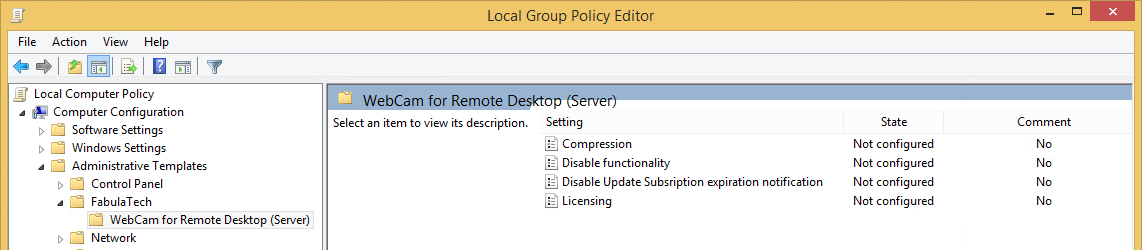
Webcam for Remote Desktop Server includes *.admx and *.adml administrative template files. These template files allow to configure the product via Local GPO and/or Domain-Based GPO. Please refer to Microsoft MSDN article on managing ADMX files.
The archive file containing administrative template can be found in the installation directory:
%ProgramFiles(x86)%\FabulaTech\Webcam for Remote Desktop (Server)\policies.zip
Additionally, the administrative template files are deployed to a local GPO during product installation and can be found here:
%WINDIR%\PolicyDefinitions\Fabulatech.admx
%WINDIR%\PolicyDefinitions\ftwebcamrdpsrv.admx
%WINDIR%\PolicyDefinitions\en-US\Fabulatech.adml
%WINDIR%\PolicyDefinitions\en-US\ftwebcamrdpsrv.adml
It's recommended to use the GPO template files provided with the latest product version of Webcam for Remote Desktop Server.
Some GPO policies can be set in different locations, depending on their target (Computer Configuration, User Configuration), or their level of applicability (FabulaTech, Product). If a policy is configured in multiple locations, the following priority order applies (from highest to lowest):
- Computer Configuration -> Administrative Templates -> FabulaTech
- User Configuration -> Administrative Templates -> FabulaTech
- Computer Configuration -> Administrative Templates -> FabulaTech -> Webcam for Remote Desktop (Server)
- User Configuration -> Administrative Templates -> FabulaTech -> Webcam for Remote Desktop (Server)
- Product settings (GUI, registry, etc.)
Policies defined at a higher level override those set at lower levels.
The GPO template can be used to configure the following settings:
| Setting | Target | Level | Description |
|---|---|---|---|
| Disable functionality | Computer, User | Product |
This policy setting is used for disabling webcam redirection functionality. If this policy setting is enabled, webcams cannot be redirected and do not appear in the webcam menu. If this policy setting is disabled or not configured, webcam redirection works and webcams appear in the webcam menu. If this policy setting is used for the computer, it overrides the policy setting for all users of this computer. |
| Disable update subscription expiration notification | Computer, User | Product |
This policy setting controls whether update subscription expiration notifications are displayed. If Enabled, the update subscription expiration notifications will not appear. If Disabled, the update subscription expiration notifications will appear. If Not Configured, the notification mode is determined by the corresponding user policy setting or the user interface setting. This policy setting overrides any user-configured preferences, meaning users cannot change the update subscription notification mode through the user interface. |
| Disable audio redirection | Computer, User | Product |
This policy setting is used for disabling audio redirection functionality. If this policy setting is enabled, audio redirection will be disabled for all users of this computer. If this policy setting is disabled, audio redirection will be enabled for all users of this computer. Also this policy setting overrides similar policy setting for all users of this computer and users will not be able to change audio redirection mode via the settings interface. If this policy setting is not configured, the audio redirection mode is determined by the similar user policy setting or via the settings interface. |
| Licensing | Computer | FabulaTech, Product |
This policy setting configures the licensing method used by the product. The following licensing modes are available:
When License Key is selected, specify the appropriate license key in the corresponding field. When License Server is selected, specify the license server address in the following format: server[:port] where server is the host name or IP address of the license server. The port is optional. If omitted, the default license server port is 33033. If this policy setting is enabled, the licensing mode and related settings defined by this policy override any configuration made through the product's settings interface. If this policy setting is disabled or not configured, the product uses the licensing configuration specified through the settings interface. Note: This policy setting can be configured at both the FabulaTech level and the product level. If this policy setting is applied at the FabulaTech level, it overrides the same policy setting applied at the product level for all installed FabulaTech products. |
| Compression | Computer, User | Product |
This policy setting allows you to manage the video compression type used. The following compression options are available:
If this policy setting is enabled, user-configured settings are overridden, and users cannot change them through the user interface. If this policy setting is disabled or not configured, the compression type is determined through the settings interface. Note: If this policy setting is applied at the computer level, it overrides the same policy setting applied at the user level for all users of this computer. |
| Log file rotation | Computer | Product |
This policy setting controls advanced log file rotation behavior. The product may create multiple logs for each user, depending on factors such as Session ID, Process ID (PID), and FabulaTech product module. Each log is stored on disk as a set of log file parts, which are created as the log is rotated. When the active log file part reaches the configured size limit, it is rotated: the current file part is renamed, and a new empty file part is created for the same log. If any of the configured limits are exceeded, the oldest log file parts are automatically removed according to the configured rules.
If this policy is disabled or not configured, log file rotation behavior is controlled by the application’s internal log rotation settings. |
| Log level | Computer | Product |
If this policy is disabled or not configured, the log level is controlled by the application’s internal logging settings. |
| Turn off "Check for updates" | Computer | FabulaTech, Product |
This policy setting determines whether the application is allowed to check for updates and notify the logged-on user.
Enabled:
Disabled:
Not Configured: Note: If this policy setting is applied at the FabulaTech level, it overrides the same policy setting applied at the product level for all installed FabulaTech products. |
| Audio device isolation mode | Computer | FabulaTech |
This setting is common for multiple FabulaTech products, including USB for Remote Desktop, Sound for Remote Desktop, and Webcam for Remote Desktop. This policy setting defines how redirected audio devices are isolated across user sessions in a multi-user environment. This setting is relevant when multiple users are logged on to the same server simultaneously and multiple audio devices are present. FabulaTech isolates audio devices within user sessions so that only the owning user can access the redirected device. To provide isolation, the program relies on a dedicated FabulaTech isolation driver. If the isolation driver is disabled or uninstalled (for example, by an administrator or security software), audio isolation may be affected. As a result, an audio device may become accessible from another user session. Important: The audio device isolation mode is determined when a user session starts. If this policy setting is changed, existing user sessions are not affected. Users must sign out and sign in again for the new isolation mode to take effect. To address such scenarios, the following isolation modes are available:
If this policy setting is Disabled or Not Configured The audio isolation mode is controlled by the local settings of the corresponding FabulaTech device redirection software (Sound for Remote Desktop, Webcam for Remote Desktop, or USB for Remote Desktop). |